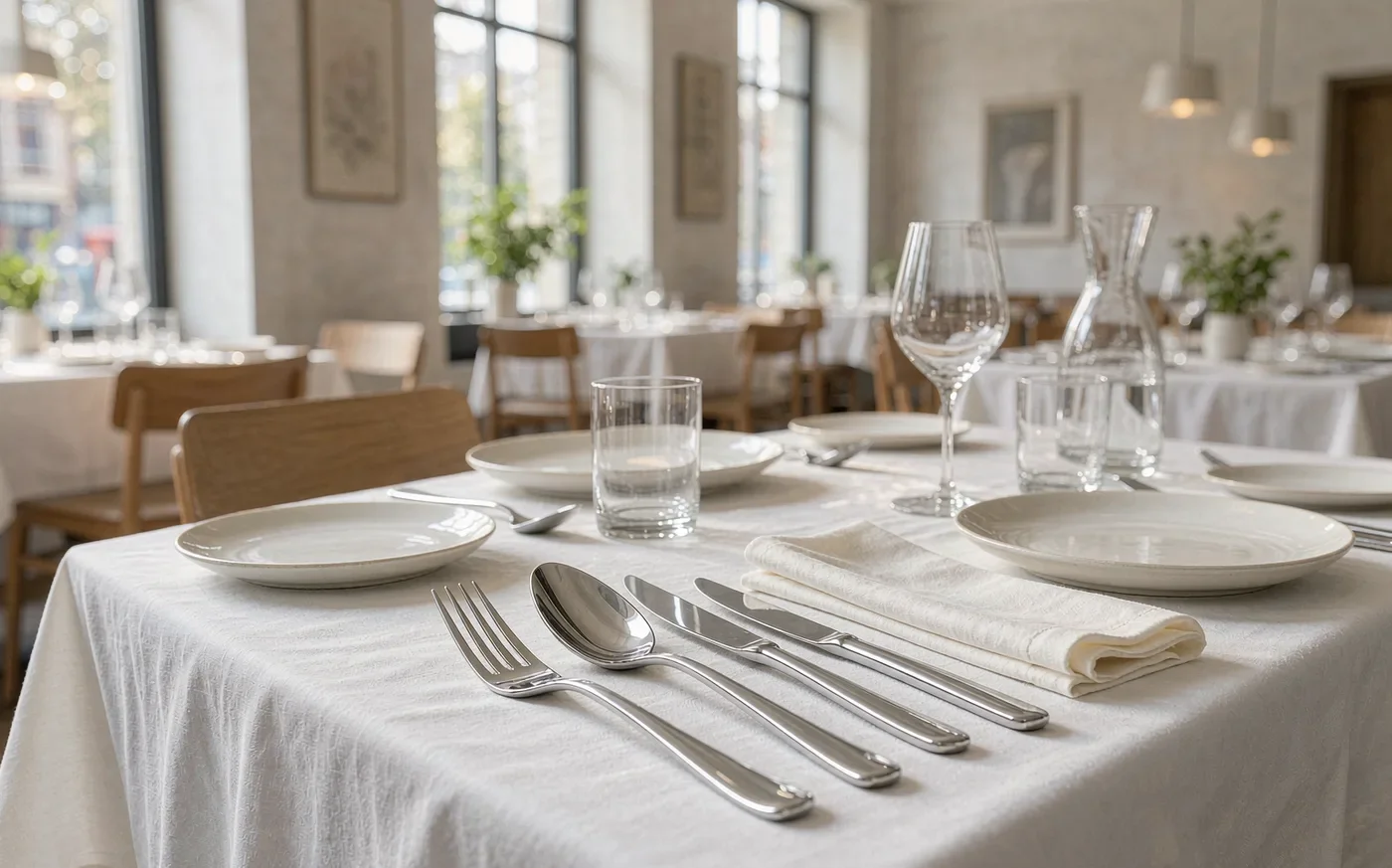
European importers tend to be more standardized than price-driven: they want a food-contact report before they talk money, and they expect the answer to be LFGB rather than only FDA. The second thing they check is whether you can pack retail-ready — a cutlery set that arrives in a printed sleeve with a barcode goes straight to the shelf; one that arrives loose in a carton becomes the distributor's problem and gets priced accordingly.
Get those two things right and you are already ahead of a large share of quotations a European buyer receives.
Germany's LFGB is broadly accepted across the EU as the reference food-contact standard, and it tests migration — what actually moves from the steel into food — rather than composition alone. Most of our European customers hold an LFGB report and use it everywhere in the region. The details of what the two standards test are covered in our FDA vs LFGB guide; for Europe, the practical summary is: ask for a current LFGB report that covers the finished product, not just the raw material.
| Channel | Typical set | What decides the price |
|---|---|---|
| Supermarket promotion | 24-piece, printed sleeve | Steel grade and packaging format |
| Department store | 72-piece, wooden case | Case construction and finish quality |
| Eco/lifestyle retail | Bamboo-handle series | Materials story and certifications |
| Foodservice | Open stock, bulk pack | Weight and grade, minimal packaging |
Bulk production for our standard items runs within 20 days of order confirmation, but sea freight to Northern Europe adds roughly 30–35 days and space tightens ahead of the autumn buying season. European buyers who order in early summer avoid both the freight squeeze and the duty paperwork rush. Payment for export orders is typically T/T with 30% deposit, with L/C available for larger programmes.
Occasionally for non-EU destinations, but for EU retail an LFGB report is the practical standard and many distributors will not review an FDA-only file. We supply LFGB documentation for our food-contact ranges.
Our standard MOQ is 100 pieces with mixed colours allowed, which suits a first container test. Fully custom sets start at 500 pieces because of tooling.
Yes. Send the barcode and the translated care panel and we print and pack retail-ready. Artwork approval to sample takes about five working days.
Send us the product, quantity and your market — we reply within 24 hours with pricing, sampling options and a realistic production schedule.
Request a quote WhatsApp us